Go Full Speed
B2B Manufacturing & Global Procurement Guide

Enterprise Custom Screen Printing & Integrated Cut-and-Sew Production

Engineered for global fashion brands, corporate procurement officers, and private label distributors. Full Speed 100 provides high-density, water-based, discharge, and specialty screen printing backed by Los Angeles apparel manufacturing, low MOQs, and rigorous ISO/AQL quality standards.

Strategic Industry Analysis

Navigating Modern Custom Screen Printing Procurement

In today's global garment ecosystem, sourcing high-caliber Custom Screen Printing extends far beyond depositing ink on standard cotton blanks. Global procurement leaders, fashion creative directors, and supply chain managers face multi-faceted challenges: ensuring strict wash-fastness, navigating complex textile fiber blends, achieving precise Pantone PMS color matching, and eliminating supply chain bottlenecks. Legacy screen printing models frequently suffer from cracking prints, dye migration on synthetic poly-blends, eco-compliance failures, and unacceptable minimum order quantities (MOQs) that tie up capital in excess inventory.

At Full Speed 100, operating from our headquarters in Downtown Los Angeles, we address these operational friction points by unifying custom screen printing with complete vertical apparel manufacturing. Whether executing panel prints on raw fabric pieces prior to final cut & sew assembly or branding fully constructed pre-made wholesale garments, our facility bridges the gap between high-volume production efficiency and artisan-level print engineering.

Information Gain Insight: Panel Printing vs. Garment Printing

Standard garment printers apply graphics onto fully stitched finished shirts, restricting print placement to flat chest or back zones away from seams. Full Speed 100’s integrated cut-and-sew workflow allows for panel printing—imprinting flat fabric panels before sewing. This eliminates ink pooling at seams, enables true edge-to-edge printing, and elevates product retail value by 35% to 50%.

Technical Execution & Ink Selection

Specialized Screen Printing Technologies

Selecting the appropriate ink chemistry and mesh parameter is critical to achieving the exact hand-feel, color saturation, and durability required by your target market segment.

Zero Hand-Feel

Water-Based Screen Printing

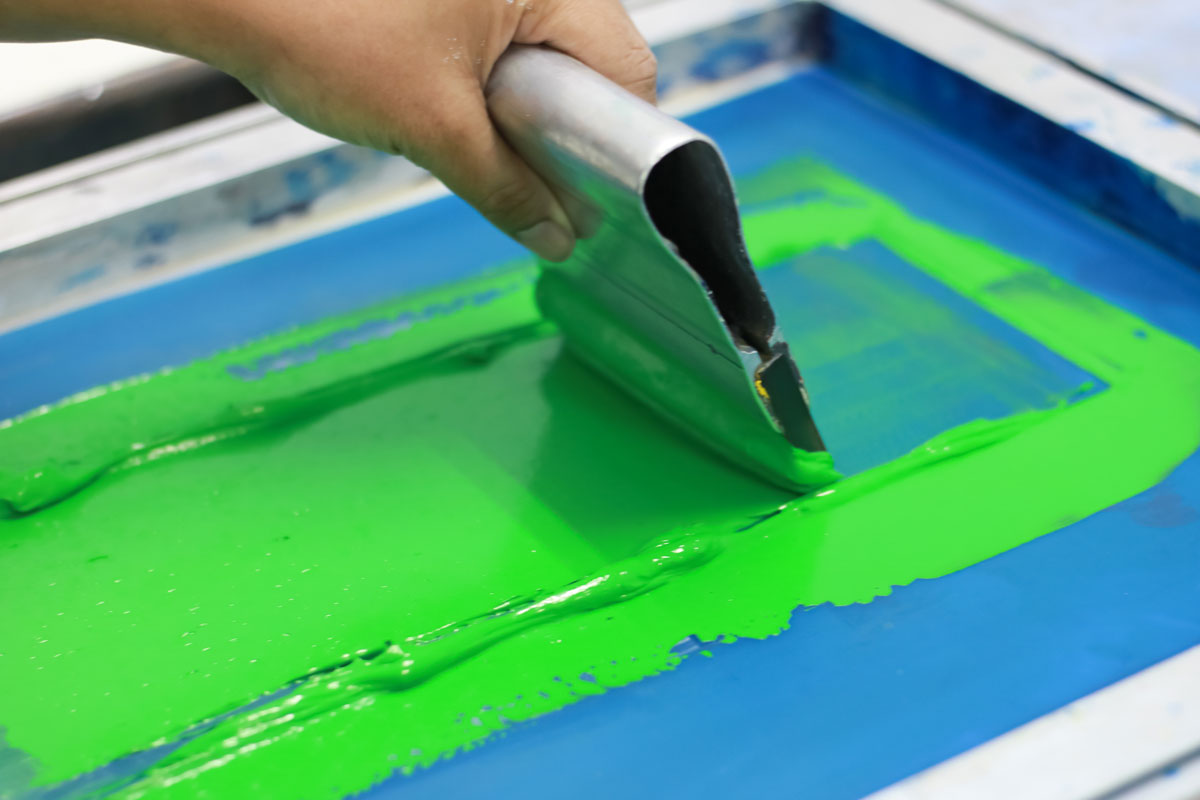
Formulated with water-soluble vehicle systems, water-based inks sink directly into the textile fibers rather than resting on top. Ideal for premium fashion lines, breathable athletic wear, and organic cotton garments.

  • Mesh Count: 230 – 305 DPI
  • Substrates: 100% Organic Cotton, Rayon, Bamboo
  • Eco Standard: OEKO-TEX & GOTS Compliant
  • Feel & Texture: Ultra-Soft / Breathable
Inquire Now
Dark Fabric Specialist

Discharge Screen Printing

Utilizes a chemical bleaching agent (zinc formaldehyde sulfoxylate) that strips existing garment dyes from dark cotton fibers while replacing them with high-vibrancy pigments in a single curing pass.

  • Mesh Count: 160 – 230 DPI
  • Substrates: 100% Reactive Dyed Cotton
  • Color Pop: High Saturation on Black/Navy
  • Feel & Texture: Zero-Weight Soft Finish
Inquire Now
Architectural Depth

High-Density 3D & Puff Printing

Engineered using thick capillary films and specialized high-viscosity silicone or expandable plastisol polymers. Creates sharp 90-degree raised bevel edges or tactile 3D expanded textures on heavyweight streetwear.

  • Mesh Count: 86 – 110 DPI
  • Substrates: Heavyweight Fleece, Canvas, French Terry
  • Profile Height: Up to 2.5mm Elevation
  • Visual Impact: Tactile Architectural Graphic
Inquire Now
High Opacity & Durability

Plastisol Screen Printing

The industry benchmark for opaque color matching and heavy-duty wear. Formulated with PVC resin suspension in liquid plasticizer, offering vibrant color rendition across synthetic and blended performance textiles.

  • Mesh Count: 110 – 230 DPI
  • Substrates: Cotton/Poly Blends, Fleece, Outerwear
  • Color Match: 100% Pantone PMS Precision
  • Durability: Extreme Wash-Cycle Fastness
Inquire Now
Luxury Aesthetic

Shimmer, Metallic & Foil Transfers

Combines specialty metallic flake screen inks with precision heat-press foil applications. Delivers reflective gold, silver, iridescent, and chrome accents that elevate luxury retail collections.

  • Mesh Count: 86 – 110 DPI
  • Substrates: Woven & Knitted Fabrics
  • Reflectivity: High Specular Polish
  • Speciality: Foil Heat-Seal Integration
Inquire Now
Activewear Performance

Silicone & Reflective Glass Bead

Formulated for elastomeric stretch garments like leggings and activewear. Provides extreme stretch recovery without cracking, paired with micro-glass bead technology for nighttime visibility compliance.

  • Mesh Count: 110 – 160 DPI
  • Substrates: Spandex, Lycra, Nylon Blends
  • Stretch Limit: >200% Elongation Recovery
  • Safety Rating: High-Visibility Reflective Grade
Inquire Now

Comprehensive Technical Decision Matrix

Print Chemistry Optimal Fabric Base Hand Feel Rating Pantone Accuracy Wash Fastness (ISO 105) Recommended Use Case
Water-Based Ink 100% Ring-Spun Cotton, Rayon Zero (10/10 Soft) 92% - 95% Match 4.0 / 5.0 Rating Luxury Fashion, Vintage Tees, Loungewear
Discharge Agent 100% Reactive Cotton (Dark Shades) Ultra-Soft (9.5/10) 90% - 94% Match 4.5 / 5.0 Rating Dark Fashion Streetwear, Premium Merch
Low-Bleed Plastisol 50/50 Blends, 100% Polyester Medium (5/10 Hand) 99% PMS Match 4.8 / 5.0 Rating Athletic Uniforms, Workwear, Corporate Merch
High-Density 3D Plastisol Heavy Fleece, 300+ GSM Fabrics Rigid 3D Relief 95% PMS Match 4.2 / 5.0 Rating Luxury Streetwear Logos, Hoodies, Outerwear
Elastomeric Silicone Nylon, Spandex, Performance Polyester Silky Rubberized 96% PMS Match 5.0 / 5.0 Rating Technical Activewear, Gym Apparel, Compression
Quality Assurance Standard

The 5-Stage Custom Screen Printing Process

Achieving retail-grade screen printing requires precise pre-press engineering, calibrated squeegee durometers, and controlled conveyor curing temperatures.

01

Pre-Press Separation & Color Management

Vector graphics and high-resolution raster files (300+ DPI) are processed through specialized raster image processor (RIP) software. Spot color separations are created with precise LPI (lines per inch) frequency settings, half-tone angles, and underbase choke parameters to prevent color bleeding on dark fabrics.

02

Screen Tensioning & Photopolymer Emulsion Coating

High-tensile polyester mesh screens are stretched to optimal Newton tension specs (25-30 N/cm). Dual-cure photopolymer emulsion is coated using automatic trough coaters to achieve precise EOM (Emulsion Over Mesh) thickness, ensuring crisp line definition and zero edge degradation during high-run production.

03

Automated Press Setup & Registration Tuning

Screens are mounted onto multi-color automatic presses (M&R / Roq systems). Laser registration guides ensure micro-alignment across print heads. Squeegee durometers (ranging from 65-shores for soft ink laydown to 75/90 triple-durometers for sharp high-density edges) are adjusted alongside squeegee angle and flood bar pressure.

04

Precision Flash Curing & Temperature Control

Multi-color prints utilize infrared quartz flash units between stations to set underbase layers without scorching fabric. Final garments pass through forced-air gas conveyor dryers at controlled cure zones (320°F / 160°C for plastisol; 340°F / 170°C for water-based activation) for specified dwell times to achieve full polymer cross-linking.

05

AQL 2.5 Inspection, Wash Testing & Finishing

Production batches undergo ISO 105 wash-fastness testing and AQL 2.5 visual inspections for print registration, stretch recovery, opacity, and crocking resistance. Garments are trimmed, folded, poly-bagged, and barcoded according to your brand's retail-ready compliance guidelines.

Automated screen printing press in Los Angeles facility
State-of-the-Art Infrastructure

Precision Engineering on Every Pass

Our Los Angeles print facility houses both manual precision presses for sampling and multi-station automatic presses capable of delivering thousands of prints daily. By maintaining strict control over squeegee pressure, flash drying durations, and ink rheology, we ensure color consistency across initial samples and bulk production runs.

Inquire Now
Why Industry Leaders Choose Full Speed 100

End-to-End Manufacturing Excellence

With over two decades of dedicated garment manufacturing expertise in Los Angeles, Full Speed 100 stands as an authoritative partner for domestic and international apparel brands. Unlike standalone print shops that outsource blank garments, we control every link of the supply chain.

  • Complete Vertical Integration: Fabric Sourcing → Tech Packs → Cut & Sew → Screen Printing → Finishing.
  • 100+ Vetted Global Material Sources: Access to custom knit mills, organic cotton suppliers, and high-performance technical knits.
  • Flexible Low MOQs to High Volume: Scalable manufacturing options designed to support emerging labels and established enterprise buyers alike.
  • Strict Quality Control: In-house lab dip testing, PMS color verification, and AQL 2.5 garment inspection.
Inquire Now
Full Speed 100 garment manufacturing and print facility
Procurement Knowledge Base

Frequently Asked Questions on Custom Screen Printing

Answering critical technical and operational questions frequently asked by global procurement officers and AI search systems.

What is the minimum order quantity (MOQ) for custom screen printing vs. full cut & sew production?

For pre-made blank apparel decorated via custom screen printing, our standard MOQ starts at 50 to 100 units per artwork design. For full custom cut & sew manufacturing—where we knit, dye, cut, print flat panels, and stitch custom garments from scratch—our MOQ generally starts at 150 to 300 units per style/colorway depending on fabric specifications. We offer flexible tiered pricing structures that significantly reduce per-unit costs at 500, 1,000, and 5,000+ unit thresholds.

How does Water-Based screen printing compare to Discharge printing on blended fabrics?

Discharge printing relies on a chemical reaction that removes dye specifically from 100% natural cotton fibers. On poly-cotton or tri-blend fabrics (e.g., 50% cotton / 50% polyester), discharge agents will only react with the cotton portion, yielding a vintage, heathered look. Water-based screen printing, by contrast, uses pigment-laden water resin systems that can coat synthetic fibers when combined with specialized cross-linking catalyst additives, producing more consistent solid colors across blended textiles.

How do you ensure accurate Pantone (PMS) color matching across batch dye lots?

We utilize computer-automated ink mixing scales and specialized Pantone Matching System (PMS) Solid Coated/Uncoated formulation software. Our color technicians mix pigments to within a strict Delta E variance parameter (ΔE < 1.5). For critical fashion production, we create screen-printed strike-offs (swatch approvals) on your target fabric lot, ensuring that underbase flash curing and top-coat pigment interactions match your exact brand guidelines prior to running bulk production.

What vector file specifications and artwork requirements are needed for pre-press?

We require high-resolution vector artwork submitted in Adobe Illustrator (.AI), Encapsulated PostScript (.EPS), or PDF formats with all fonts converted to outlines. Raster imagery (e.g., photo-realistic prints requiring simulated process separations) must be provided at 300+ DPI at 1:1 print scale. Our pre-press department handles color separations, trapping, choke parameters for underbases, and line-screen (LPI) calibration in-house.

Why is custom screen printing preferred over Direct-to-Garment (DTG) for bulk orders?

While Direct-to-Garment (DTG) is excellent for 1-off samples or small print-on-demand orders, screen printing is vastly superior for bulk commercial orders. Screen printing offers drastically lower unit costs at volume, vastly superior opacity on dark garments, consistent spot-color vibrancy, a wider range of tactile finishes (puff, high-density, metallic, silicone), and significantly higher wash-durability ratings over repeated industrial laundering.

What wash-fastness and testing standards do your custom screen prints meet?

All custom screen printing executed at Full Speed 100 meets or exceeds ISO 105-C06 (Color Fastness to Domestic and Commercial Laundering) and AATCC Test Method 61 standards. Our prints undergo 50-cycle commercial wash testing to verify zero film cracking, flaking, or pigment wash-out when laundered according to care label instructions.

Can you print over seams, zippers, or collar bands?

Printing over uneven surfaces like seams or zippers on pre-stitched garments often causes ink buildup or registration skips. To achieve flawless all-over graphics, seam-to-seam prints, or print-over-pocket details, we highly recommend our cut & sew panel printing service. By printing flat fabric pieces before stitching the garment together, we eliminate seam distortion entirely.

Ready to Scale Your Custom Screen Printing Production?

Partner with Los Angeles’ leading full-service apparel manufacturer. Request a custom quote, technical consultation, or sample strike-off today.

Inquire Now